

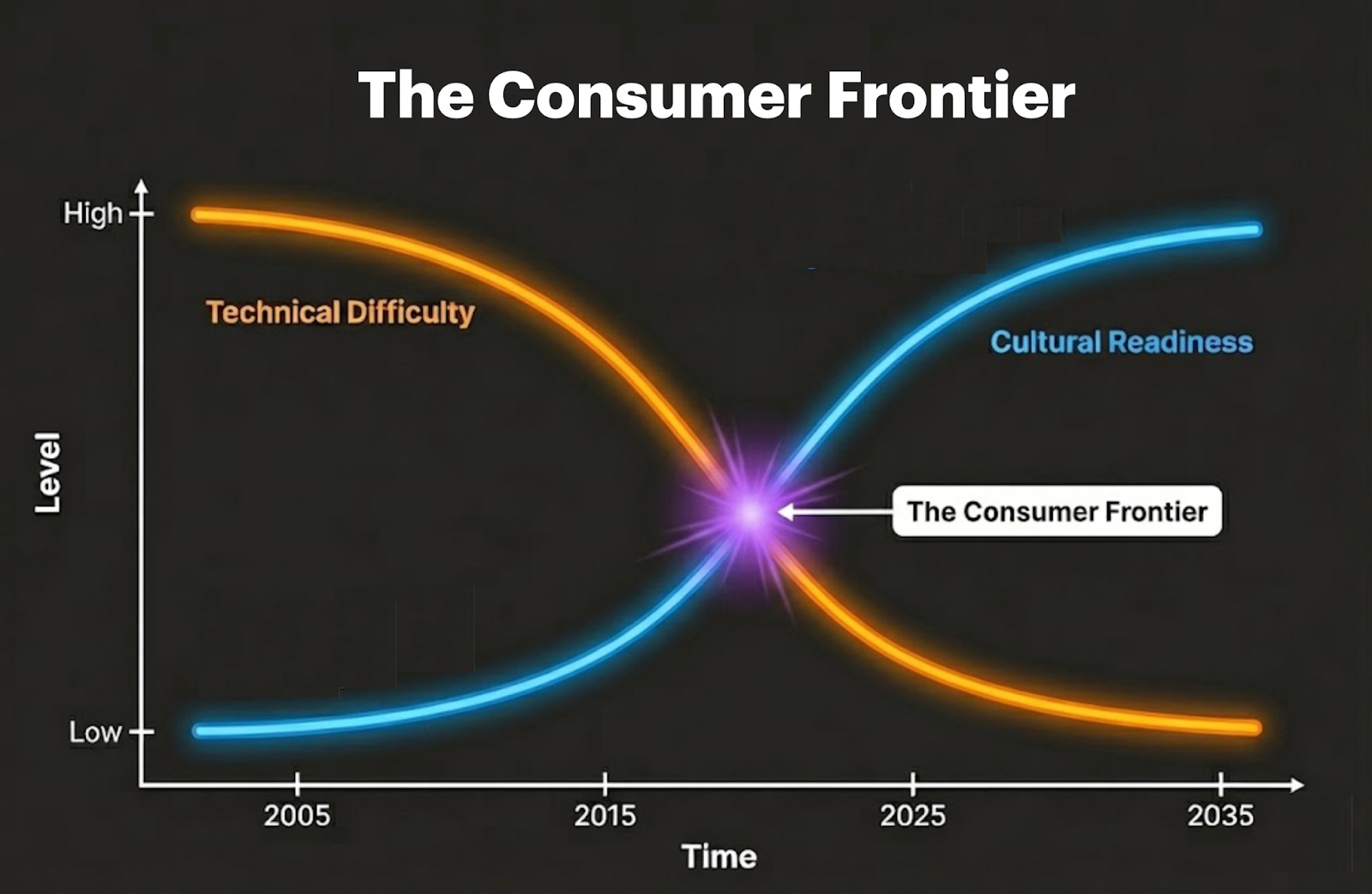
“Consumer” is the moment when technology becomes culture. It happens when two curves collide: Technological Difficulty dropping and Cultural Readiness rising. When they cross at the “consumer frontier” - entire industries explode overnight.
We saw it happen 20 years ago with software (bits), where building on web/mobile infra birthed Facebook, Twitter, Snapchat. Now, as software becomes commodity, the same collision is racing towards hardware (atoms) and biology (cells).
Here’s what happens when hard tech becomes pop culture.
Bits: Code as Content
In 2004, software was heavy. You needed $500k for servers and sysadmins. Then, the floor dropped out. AWS and App Stores turned expensive problems into cheap commodities, allowing founders with taste to express themselves (Instagram, Airbnb, Snap).
Software became pop culture.
But today, the Transformer has lowered the floor so drastically that code is just content. Trends emerge, everyone copies, trends die. “Building software” is no longer differentiating.
The most rebellious builders are suffocating. They are looking for friction and leverage. They are migrating to where the curves meet next: Atoms.
Atoms: Hardware as Fashion
Hardware used to be a startup graveyard. Today, Shenzhen is an API. You can pull sensors off the shelf like code libraries, collapsing the cost of execution. And just like in fashion, when friction disappears, behavior changes.
Hardware is now built - and worn - like fashion. When specs die, “vibe” takes over. Voice AI accelerates this by ending the tyranny of the touch screen, liberating the form factor from the black rectangle. We see this aesthetic shift clearly in Kickback, who treat gadgets as cultural artifacts. By designing for MoMA rather than Best Buy, they prove that in a world of infinite supply, one of the only moat left is culture.
But fashion has a vulnerability: cloning. If Shenzhen can build it in weeks, they can clone it in days. Because hardware now behaves like software, defensibility requires a network effect. Eno is built entirely on this premise. They sell a wearable AI badge that acts as a personal bodyguard, but the device is just the Trojan Horse. The real product is the safety mesh connecting users to one another and to emergency systems.
This brings us to the second rule of the fashion industry: supply chain is destiny. In this environment, commoditization opens the door for Second Movers to win purely through financial discipline. That’s what Orion is doing to the smart cooling mattress market. They utilize solid-state thermoelectric chips to aggressively optimize unit economics. Plus, as hardware is now becoming the “hard excuse” to sell a subscription, hardware margins begins to *sometimes* look suspiciously like SaaS ones.
And finally, we arrive at the ultimate atom: Robotics. But consumer applications mean human interaction, and humans are messy. Starlife bridges this gap with a teleoperation hybrid. They allow human operators to “teleport” into humanoid robots, effectively turning physical labor into remote work. By keeping humans in the loop, they handle the nuance of reality today while building the training data for the autonomy of tomorrow.
Hardware in 2025 is Software in 2009. Atoms are cool. You know what’s cooler? Cells.
Cells: The Body as a Platform
Biotech today looks like the Internet in 1994. You no longer need a PhD or a $10M wet lab to play. The stack is commoditizing into a familiar Read/Write loop, where sequencing lets us read the code and synthesis lets us write it.
The technology is ready, and thanks to Covid, the culture is too. The State’s monopoly on health - what Foucault called “Biopower” - fractured during the pandemic. As trust in institutions dissolved, consumers began using their own capital to gain agency. Different Health operationalizes this shift, allowing users to run clinical tests to optimize their biological age. It turns out that narcissism is often the quickest path to consumer adoption.
To democratize the results, you must democratize the hardware. Acorn Genetics solves the lab centralization problem by shrinking a standard sequencer into a portable, low-cost unit. This immediately changes the unit economics for SMBs: dairy farmers and brewers can now run tests on-site, saving weeks of waiting and preventing wasted batches. And once this hardware is validated on the farm, and cost goes down, it will inevitably migrate to the home, bringing clinical-grade health testing to the consumer.
Access to data inevitably creates a demand for action. GLP-1s triggered the main event, but the explosion of gray-market peptides shows that consumers aren’t willing to wait for regulatory permission to edit their own code. Because this demand outpaces the FDA, startups must find structural workarounds. Metabologic is the perfect case study. Instead of a decade-long drug trial, they launched their sugar-deleting enzyme as a supplement. They get to deploy hard science with the speed of a consumer brand.
Biology is finally moving at the speed of culture. Longevity trends now cycle like fashion. A peptide goes from a subreddit rumor to a bestseller in weeks. It looks like a toy right now - unregulated and vanity-focused - but that is exactly what a frontier looks like before it becomes the standard.
Narrative as a Moat.
There is one catch.
When you play on the frontier, the public is watching. Robotics and bio-hacking feel like magic. They also feel scary.
You need a story. You need a narrative that is transparent and optimistic. If you don’t control your story, the internet will invent one for you - probably dystopian.
The frontier needs storytellers as much as engineers. The next wave of consumer adoption will be driven by people who can turn increasingly complex tech into culture. Who can make a wearable AI feel like a superpower. Who can make longevity supplements feel like self-improvement.
The Consumer Frontier moment is here. The tech is easy enough. The culture is ready enough. The only thing left to do is build.
If you are, let’s chat!
interesting piece!